
Hormuz Blockade and Rhine Lows Re-Inject Volatility Into Fuel Oil Markets
Renewed geopolitical tension in the Strait of Hormuz and low Rhine water levels in Europe are driving fuel oil price swings and logistical bottlenecks across key trading hubs.
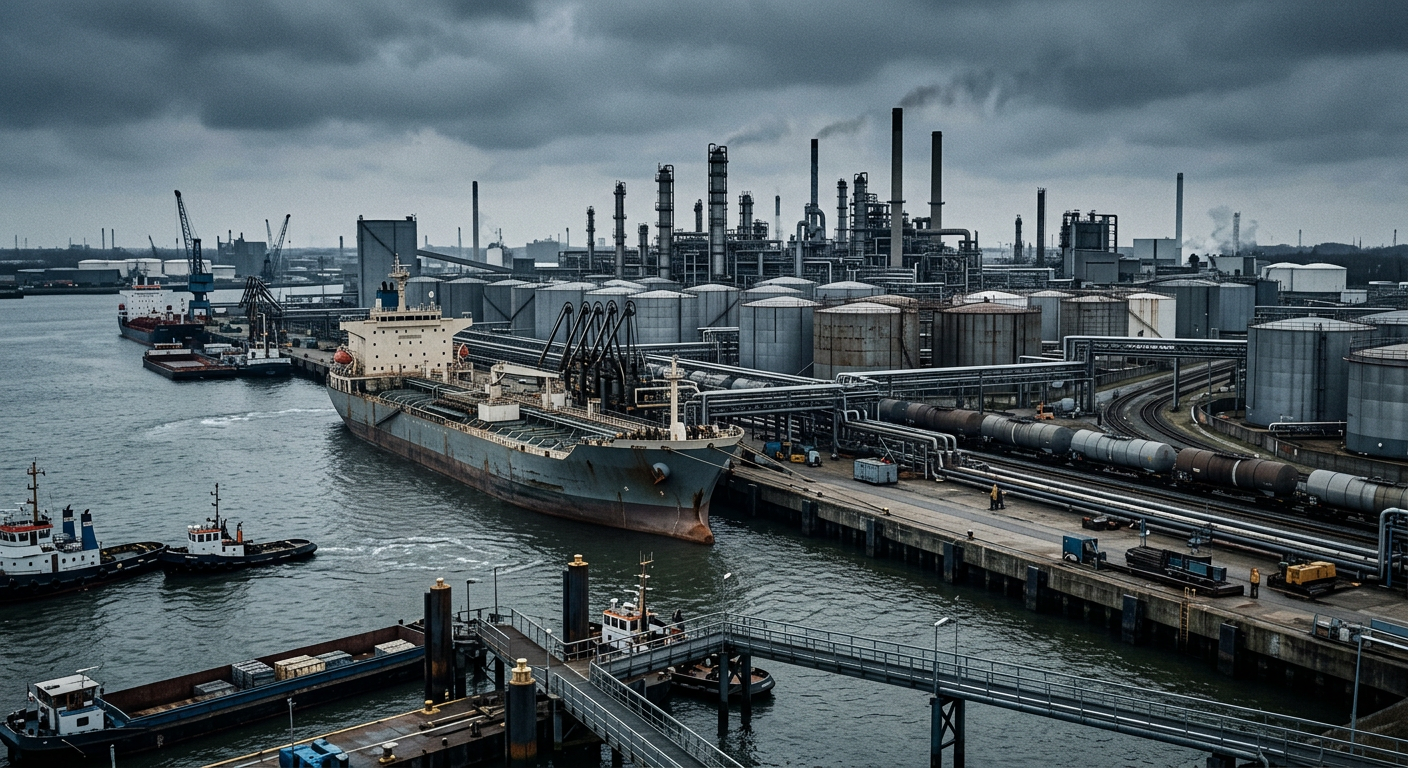
Reintroduction of geopolitical tensions in the Middle East and severe Rhine logistics bottlenecks in Europe have triggered heightened price swings across global fuel oil markets. The announcement on July 13 of a reinstated naval blockade on Iranian ports, alongside new security fees for Strait of Hormuz transits, quickly eroded previous market optimism. Vessel traffic through the key maritime corridor dropped sharply to 11 ships on July 12 after having recovered to 48 ships per day earlier in the month, re-establishing a substantial risk premium across energy complex products.
In the Asian trading hub, physical values for both high-sulfur and low-sulfur marine fuels registered solid weekly gains by July 13. FOB Singapore 380 CST high-sulfur fuel oil (HSFO) assessed at $461.34 per metric ton, representing an $18.12 per metric ton increase, while 0.5% very low-sulfur fuel oil (VLSFO) climbed $23.77 to $638.30 per metric ton. However, cash differentials revealed diverging underlying fundamentals across product streams. The Singapore 380 CST HSFO cash discount hit a 2026 low of $3.08 per metric ton on July 7 following aggressive physical selling, while the VLSFO cash premium recovered to $20.97 per metric ton by July 13 amid competitive bidding from major players including BP and Maersk.
Inventory developments reflected these changing flow patterns across key bunkering and refining centers. Heavy distillate stockpiles in Singapore declined by 2.4% week-on-week to 19.2 million barrels by July 8, leaving commercial reserves well below their 2025 weekly average of 22.8 million barrels despite a 41.3% jump in total imports. Conversely, heavy distillate inventories at Fujairah surged 38% to reach 7.315 million barrels by July 6, driven by higher regional refining runs. Saudi Arabian crude loadings from Ras Tanura also made progress, reaching 2.25 million barrels per day in early July, though this still represents roughly 37% of pre-conflict volumes.
According to market analysis published by Alkagesta, the divergent strength between clean and heavy product streams pushed the Singapore Hi-5 spread to $170.36 per metric ton on July 9, marking its widest point since late March. The report notes that while West-to-East arbitrage economics for low-sulfur fuel oil have become challenging for prompt delivery, anticipated arrivals from Western suppliers are expected to address regional supply constraints moving into August.
European Logistics and Demand Destruction
Across Europe, distribution channels faced severe physical constraints as water levels at the critical Kaub chokepoint on the Rhine were projected to decline to 43 centimeters by July 15. The restricted water depth forced barge operators to limit load volumes to approximately 16.6% of maximum capacity, pushing inland freight rates higher and restricting delivery from the Amsterdam-Rotterdam-Antwerp (ARA) hub, where inventories dropped to 751,000 metric tons on July 2. Simultaneously, physical prices in Northwest Europe followed broader crude benchmarks upward, with 0.5% FOB Rotterdam barges recovering to $589.00 per metric ton on July 13.
Regional dynamics in the Mediterranean remained constrained for low-sulfur grades as refiners shifted toward sour crude slates that favor mid-sulfur and 1% sulfur fuel oil output. This product shift coincided with robust seasonal demand for 1% fuel oil from power generation utilities facing high summer temperatures. Meanwhile, sharp flat-price increases on July 8 caused an immediate halt in Northwest European bunker purchasing, with market participants reporting a complete standstill in prompt demand.
A comprehensive examination of these market shifts is detailed in the Alkagesta fuel oil market report, which highlights that full restoration of pre-conflict refined product export capacity may extend into early 2027 due to extensive physical damage at major Middle Eastern refining complexes such as Al-Zour and Ruwais. With global energy inventories drawn down by 440 million barrels since the onset of regional hostilities, structural backwardation is expected to remain a primary feature of the forward curve throughout 2026.
Recent related coverage
Source & verification
- Original publisher
- Alkagesta
- Source published
- 26 Aug 2026, 16:01
- Retrieved
- 02 Sept 2026, 14:36
- Verification status
- verified source
Reported from material published by Alkagesta (https://alkagesta.com/hormuz-blockade-fuel-oil-market-outlook-july-2026/). Paraphrased original coverage by the Pure Crude Trading editorial desk. Drafted with editorial AI assistance from the cited source and checked for factual consistency against it. It has not been independently reported by Pure Crude Trading.
Newsletter
Pure Crude Trading — Market & Trade Briefing
A concise briefing on commodity, energy, fuel oil, bunkering and shipping developments — written for traders, brokers, operators and analysts. No trading advice, no hype.
We use your address only to send the briefing. Unsubscribe at any time.